The Hidden Cost of Slow Hiring: A Practical Framework to Help HR Teams Recruit Better, Faster, and Smarter
Hiring has never been more important—or more difficult.
Across industries, HR teams face increasing pressure to fill positions quickly while maintaining hiring quality. Business leaders expect faster recruitment, candidates expect seamless experiences, and recruiters are expected to achieve both with limited resources.
Unfortunately, many organizations continue to rely on recruitment processes that were designed for a completely different hiring landscape.
The result?
- High-quality candidates accept competing offers.
- Recruiters spend hours screening irrelevant applications.
- Hiring managers become frustrated with delays.
- Open positions begin affecting revenue, productivity, and customer satisfaction.
The challenge isn't a shortage of talent.
It's the inability to identify and engage the right talent before someone else does.
Modern recruitment requires smarter systems—not simply more recruiters.
This is where AI-assisted recruitment is becoming an essential advantage rather than an optional technology.
Why Slow Hiring Is More Expensive Than Most Companies Realize
Many organizations calculate recruitment costs based only on advertising expenses or recruiter salaries.
The real cost is much larger.
Every unfilled role creates hidden business losses that accumulate daily.
| Recruitment Delay | Business Impact |
|---|---|
| Longer Time-to-Hire | Lost productivity |
| Delayed Projects | Missed revenue opportunities |
| Candidate Drop-offs | Strong talent joins competitors |
| Recruiter Workload | Higher operational costs |
| Poor Candidate Experience | Employer brand suffers |
Research consistently shows that skilled candidates often remain available for only a short period before accepting another offer.
That means every unnecessary approval step, manual screening process, or delayed communication increases the likelihood of losing your preferred candidate.
The companies winning today's talent market aren't necessarily offering the highest salaries.
They're offering the fastest, most organized hiring experience.
The Recruitment Funnel Has Changed
A decade ago, posting a job and waiting for applications was often enough.
Today, recruiters compete in an environment where candidates have:
- Multiple job portals
- AI-generated resumes
- Better salary transparency
- Faster application processes
- Higher expectations for communication
This has fundamentally changed recruitment.
Instead of reviewing hundreds of resumes manually, successful HR teams focus on improving three critical metrics:
1. Candidate Quality
More applications do not automatically mean better hiring.
Recruiters need qualified candidates—not simply higher application numbers.
2. Time-to-Hire
Reducing hiring cycles improves offer acceptance rates while lowering recruitment costs.
3. Recruiter Productivity
Recruiters create the most value when they spend time interviewing and engaging candidates—not formatting resumes or manually organizing spreadsheets.
A Modern Recruitment Framework for HR Teams
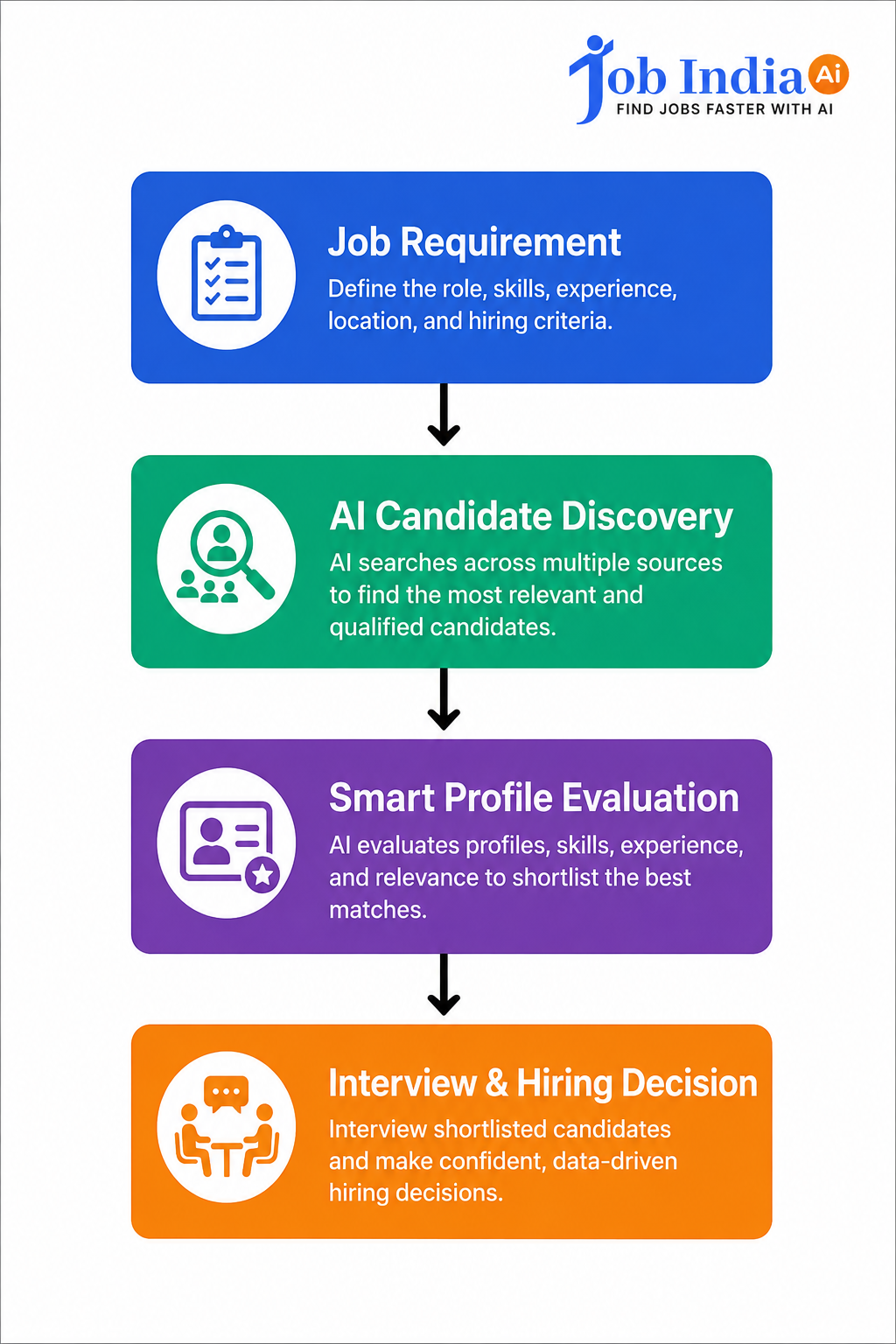
Instead of thinking about recruitment as a series of disconnected tasks, successful organizations build hiring systems around four connected stages.
Job Requirement
│
▼
AI Candidate Discovery
│
▼
Smart Profile Evaluation
│
▼
Interview & Hiring Decision
Each stage should reduce manual effort while improving hiring accuracy.
The goal isn't replacing recruiters.
It's allowing recruiters to focus on human decision-making instead of repetitive administrative work.
Where Recruiters Lose the Most Time
Let's examine a typical recruitment process.
Traditional Workflow
- Create job description
- Publish job on multiple portals
- Wait for applications
- Download resumes
- Organize spreadsheets
- Screen resumes manually
- Contact shortlisted candidates
- Schedule interviews
- Repeat
Now compare that with an AI-supported workflow.
AI-Assisted Workflow
- Publish one structured job posting
- Intelligent candidate recommendations
- AI-generated candidate profiles
- Resume standardization
- Faster filtering
- Better matching
- Real-time applicant management
The difference isn't simply automation.
It's reducing repetitive work so recruiters spend more time evaluating talent.
A Familiar Scenario Every HR Professional Recognizes
Imagine you're hiring ten Customer Support Executives.
Within five days, you receive 1,200 applications.
Your recruitment team now spends:
- Opening resumes
- Comparing qualifications
- Checking employment history
- Creating candidate summaries
- Updating spreadsheets
- Following up individually
By the time interviews begin, your strongest candidates may already have accepted another opportunity.
Now imagine receiving the same application volume—but every candidate profile is automatically structured, searchable, and categorized based on relevant hiring criteria.
Instead of reviewing every resume manually, recruiters begin with the most suitable candidates first.
That small improvement can reduce hiring time dramatically.
AI Is Becoming an HR Productivity Tool
There's a misconception that AI is replacing recruiters.
The reality is very different.
The best AI recruitment tools eliminate repetitive administrative work.
Recruiters still make hiring decisions.
Managers still conduct interviews.
Organizations still evaluate cultural fit.
AI simply accelerates the tasks that previously consumed hours.
Examples include:
- AI Resume Builder for candidates
- Intelligent profile creation
- Better job recommendations
- Automated profile organization
- Faster candidate discovery
- Smart filtering based on hiring requirements
These capabilities help recruiters spend more time hiring—and less time processing information.
Five Recruitment Trends Every HR Leader Should Watch
1. Candidate Experience Matters More Than Ever
Candidates judge employers by their hiring process.
Fast communication creates trust.
Delayed communication creates uncertainty.
2. Mobile Recruitment Continues to Grow
Most job seekers now search for opportunities using smartphones.
Platforms optimized for mobile applications receive stronger engagement.
3. AI Improves Recruiter Efficiency
The focus has shifted from replacing recruiters to helping recruiters make faster, better decisions.
4. Skills-Based Hiring Is Expanding
Organizations increasingly evaluate practical skills alongside degrees and experience.
This widens access to qualified talent.
5. Recruitment Analytics Are Becoming Essential
Leading HR teams monitor:
- Time-to-hire
- Cost-per-hire
- Offer acceptance rate
- Source effectiveness
- Candidate conversion rates
Better data produces better hiring decisions.
What HR Teams Should Look for in Recruitment Technology
Choosing recruitment software shouldn't begin with feature comparisons.
It should begin with operational challenges.
Ask these questions:
✅ Can recruiters identify qualified candidates quickly?
✅ Is the candidate experience simple?
✅ Does the platform reduce manual work?
✅ Can hiring managers collaborate easily?
✅ Does the technology improve hiring speed?
If the answer to these questions is "yes," the platform contributes measurable business value.
Why AI-Powered Recruitment Platforms Are Becoming the New Standard
Recruitment technology should simplify hiring—not complicate it.
Modern HR teams increasingly prefer platforms that combine:
- Intelligent job matching
- AI-assisted profile creation
- Resume building
- Candidate discovery
- Employer branding
- Centralized recruitment workflows
Rather than switching between multiple systems, recruiters benefit from one integrated hiring environment.
This approach reduces administrative work while improving hiring consistency across departments.
How Job India AI Helps Recruiters Focus on Hiring Instead of Administration
Every HR professional wants the same outcome:
Find qualified candidates faster without increasing recruitment costs.
That objective becomes easier when technology removes repetitive tasks from the hiring process.
Job India AI has been designed with this philosophy.
Instead of overwhelming recruiters with unnecessary complexity, the platform helps streamline the recruitment journey through features such as:
- AI-powered candidate profile creation
- AI Resume Builder
- Intelligent candidate discovery
- Category-based job search
- Real-time application management
- Mobile-first recruitment experience
- Employer-friendly hiring workflows
The result is a hiring process that is faster, more organized, and better aligned with the expectations of today's candidates and recruiters.
Rather than replacing human judgment, Job India AI gives HR teams better information, faster access to qualified talent, and more time to focus on meaningful hiring decisions.
The Future of Recruitment Belongs to Efficient HR Teams
The organizations that consistently attract top talent are rarely the ones with the largest recruitment budgets.
They're the ones with the most efficient hiring processes.
Recruitment success today depends on speed, candidate experience, data, and intelligent technology working together.
HR professionals who embrace AI-assisted recruitment aren't replacing human expertise—they're enhancing it.
Every hour saved on manual screening is another hour spent interviewing, engaging candidates, and making stronger hiring decisions.
If your recruitment team is looking for a simpler way to reduce hiring delays, improve recruiter productivity, and connect with quality candidates faster, visit www.jobindia.ai and explore how AI-powered hiring can transform your recruitment workflow. Whether you're hiring five people or five hundred, Job India AI helps your team spend less time searching and more time hiring the right talent.